AI for science should be judged differently from an ordinary product feature. A compelling output is not the end of the workflow; it is a candidate explanation, structure or experiment that must be connected to data provenance, uncertainty and independent validation. The most valuable systems shorten the cycle between a scientific question and a testable next step, rather than simply generating a more persuasive visual.
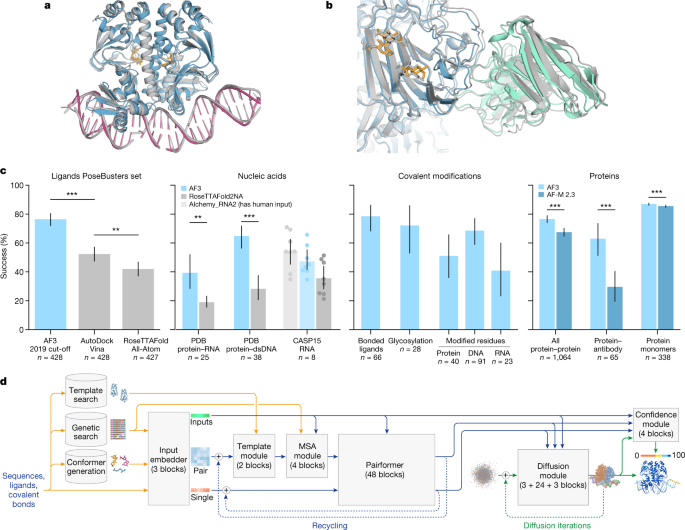
AlphaFold 3 is a useful case study because the published work addresses biomolecular interactions while the released inference pipeline makes concrete operational demands. The project documentation distinguishes the code, model parameters, data pipeline and input formats. Those details matter: a result depends on how sequences, ligands, templates and other evidence entered the system, not just on the final predicted structure.
This is why scientific teams need to preserve a chain of evidence. Record the input version, the model and parameter version, the preprocessing choices, the confidence signals and the experiment that would challenge the result. A prediction can prioritize work, but it should not inherit the status of an empirical finding merely because it is presented with scientific vocabulary.
The best first application is a narrow bottleneck with an existing validation loop: ranking candidates for an assay, organizing literature evidence, or proposing a small set of testable hypotheses. Measure whether the system improves the quality or speed of the next experiment. That is the standard that matters—not whether an AI system can produce a dramatic standalone result.