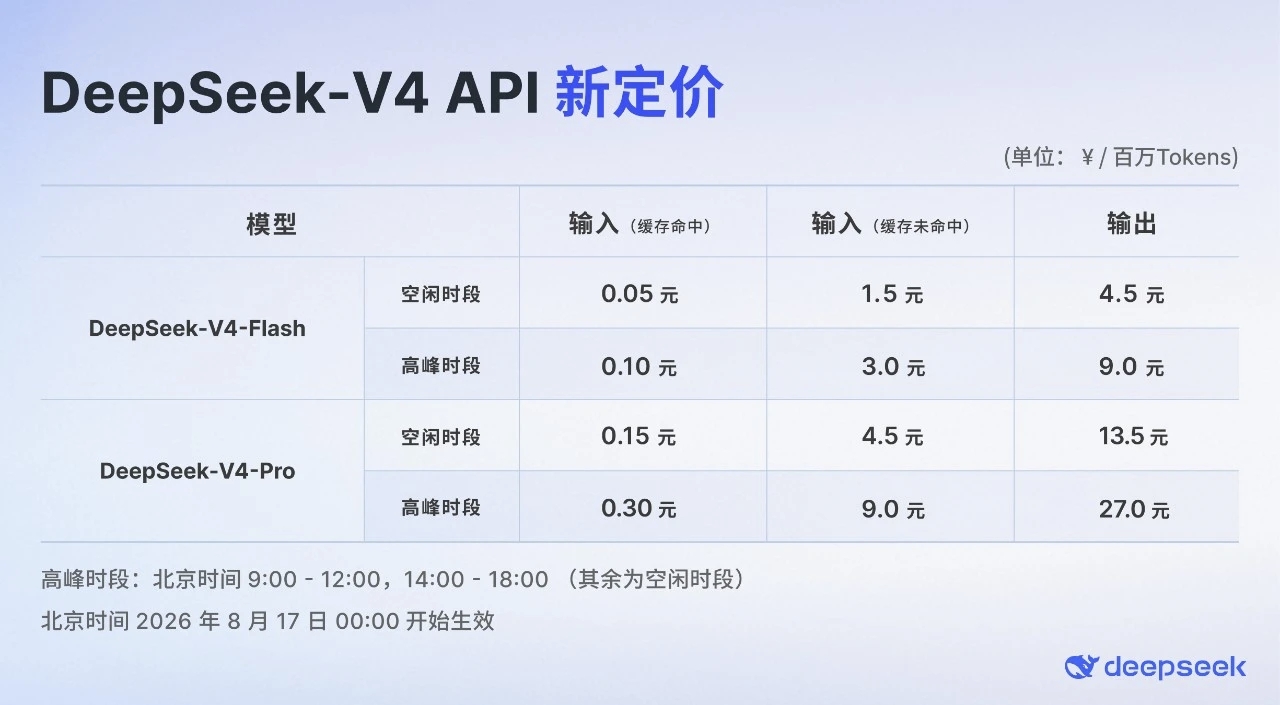
DeepSeek has published a new V4 API pricing card, with rates scheduled to change at 00:00 Beijing time on August 17, 2026. For developers searching DeepSeek price, DeepSeek pricing, or DeepSeek V4 Pro pricing, the important change is not a new model name. It is a new operating rule: V4 Flash and V4 Pro will both have separate peak and off-peak prices.
The rate card lists prices in Chinese yuan per one million tokens. V4 Flash is priced at ¥0.05 for cache-hit input, ¥1.50 for cache-miss input, and ¥4.50 for output in off-peak periods. At peak times, those rates become ¥0.10, ¥3.00, and ¥9.00. V4 Pro is listed at ¥0.15, ¥4.50, and ¥13.50 off-peak, rising to ¥0.30, ¥9.00, and ¥27.00 at peak times.
The stated peak windows are 09:00–12:00 and 14:00–18:00 Beijing time. All remaining hours are off-peak. That makes the timing of a request part of the cost calculation, particularly for teams running batch jobs, agent loops, evaluations, or long-context coding tasks.
The price increase is uneven, not universal
The new table makes three choices matter more than they did before: which V4 model handles the task, whether the request reuses cached context, and when the work runs. Cache-hit input remains dramatically cheaper than cache-miss input. That is a strong signal to keep stable system prompts, tool descriptions, repository rules, and long-lived context consistent instead of rebuilding them on every turn.
The peak multiplier is also clear. Every listed rate doubles during the two daytime windows. A latency-sensitive interactive product may have to absorb that. A queue for report generation, repository analysis, offline evaluation, or back-office automation does not. Those jobs can be scheduled around the off-peak clock.
V4 Pro should be an escalation path
V4 Pro is still the route for the tasks where extra reasoning, long context, or a more capable coding agent is worth paying for. But a higher-output price makes a blanket Pro default harder to justify. Use Flash for classification, extraction, drafting, routine transformations, and lightweight agent steps; reserve Pro for planning, difficult debugging, final review, and tasks where a failed answer costs more than another model call.
That model split is not a downgrade. It is a practical routing policy. The cheapest high-quality workflow is usually a chain of smaller decisions, not a single expensive model assigned to every intermediate step.
What API teams should change before August 17
First, inspect usage by model, hour, input cache status, and output length. A team that only sees a monthly total cannot tell whether it is paying for useful reasoning or repeated context. Second, move deferrable workloads into the off-peak window. Third, set output limits and stop conditions for agent runs so a looping task cannot turn a modest request into an expensive one.
Finally, treat the live pricing documentation as the billing authority. The announcement card gives the scheduled August 17 rates, while DeepSeek's pricing documentation remains the place to verify model availability, billing terms, and any subsequent revisions before changing production budgets.
Sources and publication record
Source material is linked for readers who want to verify the underlying announcement or documentation.